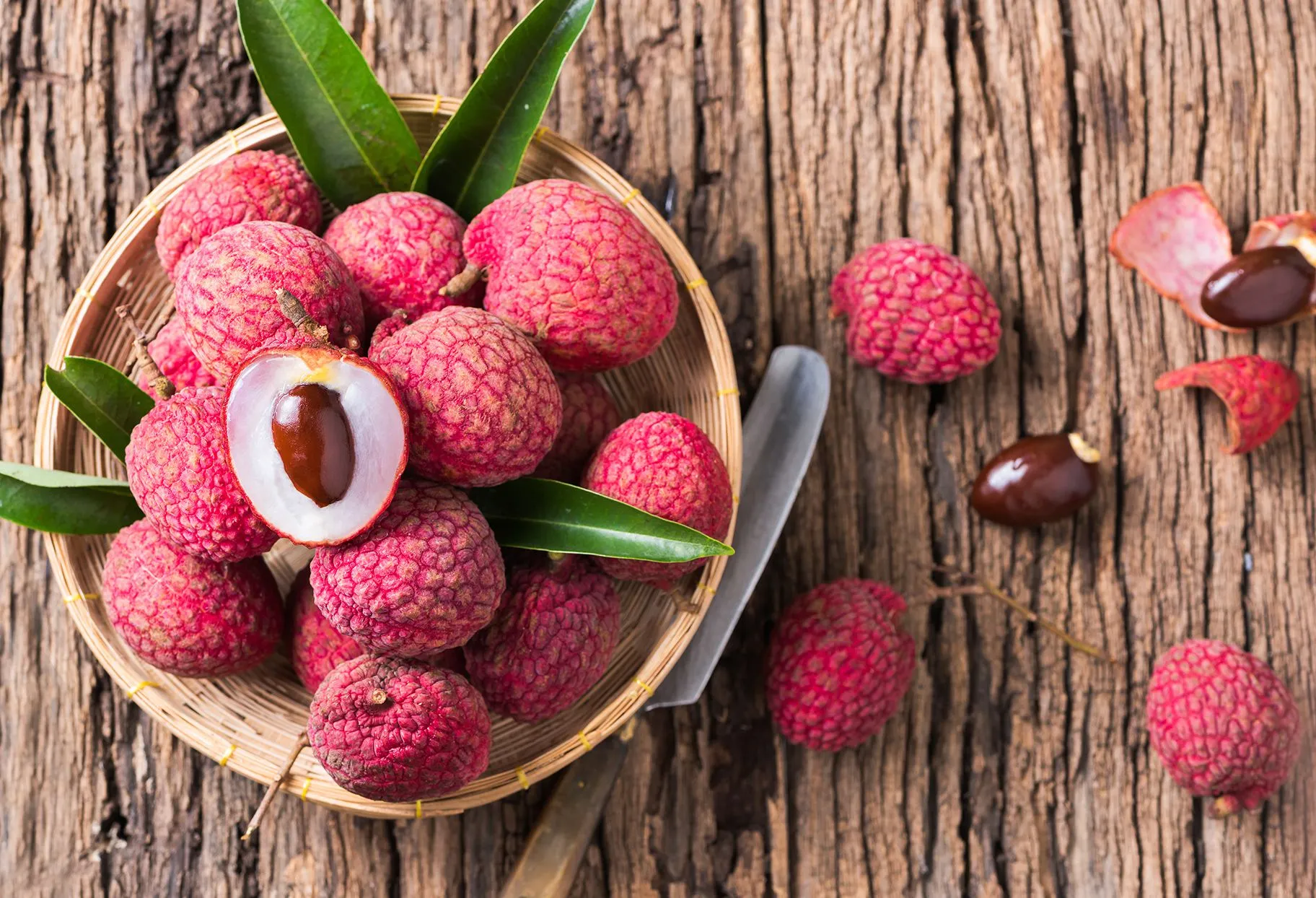
- Lychee is a sweet, floral tropical fruit Native to southern China. It has a red shell and translucent white flesh.
- Lychees are available fresh from May to September or canned year-round. Store fresh lychees in the shell for up to two weeks.
- Enjoy them plain, in cocktails, or in desserts by peeling the skin and eating the juicy fruit while discarding the seed.
Lychee is a white, almost transparent fruit with a hard red shell. A staple in Asian cuisine, it has started showing up more and more on American menus, especially in cocktails and desserts. You may have seen lychee martinis on the menu at your favorite local sushi restaurant.
In this guide, we’ll tell you how lychee tastes, how to eat it, where to buy it, and more about this wonderful tropical fruit.
Try MyRecipes, our digital recipe box, to stash and organize all your favorite Better Homes & Gardens recipes.
What Is Lychee?
Lychee (Litchi chinensis) is a fruit that belongs to the soapberry family, Sapindaceae, and is native to the provinces of Kwangtung and Fukien in southern China. A lychee tree grows between 30 and 100 feet and produces clusters of 2-20 pieces of fruit.
The exterior of the fruit is red, oval-shaped, and about 1-2 inches wide. Beneath the skin lies the thick, translucent-white portion of lychee fruit covering a seed. Choose fresh lychee fruit that is reddish-pink (though browner skins are perfectly OK to eat as well).
Lychee is either pronounced LEE-chee (United States) or LIE-chee (UK and Australia).
When Is Lychee Season?
Since they need a tropical climate to grow, lychees are often imported (except in Hawaii and some areas of California and Florida). Peak seasons vary depending on the country they’re coming from, but mostly show up in the United States from May to September. If you get your hands on fresh lychees, store them for up to one week wrapped in a paper towel inside a breathable or perforated storage bag.
Related
Lychee Benefits
Lychee contains a decent amount of vitamin C and is a great option for meeting your daily fruit serving. Some studies show that fresh lychee fruit contains antioxidant and anti-inflammatory properties.
Lychee vs. Rambutan
Mostly found in Malaysia and Thailand, rambutan is very similar to lychees in flavor and texture, but it’s the appearance that will make you take a second look due to its “hairy” exterior. (The term “rambut” means hair in Malay.) Rambutan is also less acidic than lychee, with a flavor profile similar to that of a strawberry.
How to Eat Lychee
Don’t let that tough exterior scare you. First, crack open the lychee just below the stem. From there, the leathery red skin is easily peeled away (or popped out by squeezing from the opposite end) to reveal the fleshy white, glossy fruit that feels sort of like a grape without the peel. Eat the lychee fruit just like you would a cherry, discarding the seed. For the best flavor, lychees shouldn’t be peeled until just before being eaten or served.
What Does Lychee Taste Like?
The aromatic lychee is sweet, with slightly floral and acidic notes. Texturally, it’s sort of like a firm, crisp grape. Upon biting, you’ll get a juicy, sweet-tart flavor burst with a taste similar to strawberry or pear with a hint of citrus. Some also compare the floral taste to rose.
Where to Buy Lychee
Look for lychees at your local Asian or international market. Choose ripe fruit with bright red skin and a soft, but not mushy, texture. Keep the lychees refrigerated in the shell for up to two weeks.
If there aren’t any fresh lychees in stock, there are also canned lychees, which are delicious frozen or served over ice. Fresh or canned, enjoy lychee plain as a snack, in a cocktail, or even in a savory salsa.
- <span>Recipes & Cooking</span>
- <span>How to Cook</span>
- <span>Ingredient Explainers</span>
“Lychee.” Purdue University.
Yoshigai, Emi et al. "The Anti-Inflammatory Effects of Flavanol-Rich Lychee Fruit Extract in Rat Hepatocytes." PLoS One, vol. 9, no. 4, 2014, doi: 10.1371/journal.pone.0093818
Liu, Yu et al. "Identification of Proanthocyanidins From Litchi (Litchi chinensis Sonn.) Pulp by LC-ESI-Q-TOF-MS and Their Antioxidant Activity." PLoS One, vol.10, no. 3, 2015, doi: 10.1371/journal.pone.0120480
New